

5 Yoga Poses That Don't Serve Most Women Over 50 Anymore
And what to do instead — from a teacher who recently had to take her own advice.
Note: this post isn't for the longtime practitioner who does these poses regularly and feels great.
I've been teaching yoga since 2001. I've guided thousands of women through sun salutations, inversions, hip openers, and everything in between. And I'm here to tell you: some of the poses we've been faithfully practicing — poses that are practically synonymous with yoga — deserve a second look.
This isn't a takedown. It's not "yoga is bad" or "these poses will hurt you." It's something more nuanced – and useful – than that: some poses that were fine when you were doing them regularly, in a body that was warmed up and trained for them (and let’s be honest, in a body that recovered faster), become a different proposition entirely when you come back to them after time away. Or when your body has simply changed — because bodies do.
I know this firsthand. More on that in a moment.
First, let's talk about the poses.
1. Chaturanga Dandasana (Four-Limbed Staff Pose)
This one probably doesn’t surprise you. Chaturanga is the workhorse of vinyasa yoga. It shows up in nearly every flow class, sometimes dozens of times in a single practice. And for a lot of women, it's quietly wrecking their shoulders.
The issue isn't the movement itself — a lowering push-up is a genuinely valuable thing to be able to do. The issue is that most of us were never taught to build up to it. We just... did it. Repeatedly. On the first day of class and every day after.
Compounding this: for decades, yoga teachers (including me, early in my career) passed along the cue that your elbows must stay hugged in close to your ribs. It felt like gospel. Turns out, exercise science doesn't support it as a universal rule. Your elbows can wing out and your hands can be anywhere, not just “back my your ribs” — for many people, that's actually more natural and puts less strain on the shoulder joint. The "elbows in" rule likely caused more problems than it prevented.
What to do instead: Any push-up variation that you can do with good form is better than a chaturanga you're grinding through. Wall push-ups, incline push-ups with hands on a chair or countertop, a standard push-up on your knees — all of these build real pushing strength without the loading issues of a full chaturanga. And a solid plank hold on forearms or hands? Genuinely excellent. Let your elbows go where they want to go (just keep your shoulders low – I had to!).
2. Headstand and Shoulderstand
Now, these might seem obvious if you’ve never done these poses. I’m talking to those of us who used to do them regularly (Iyengar class, anyone?). These are the King and Queen of yoga poses, so designated because they supposedly bestow enormous benefits — improved circulation, calm nervous system, whole-body integration. I'm not here to argue with the tradition.
The issue is, many of us stopped doing these poses years ago. Maybe we took a break. Maybe we had a neck tweak, or started a new job, or life got busy. And then one day we tried to float back up into headstand and discovered that the strength and body awareness required to do it safely had quietly departed.
Headstand and shoulderstand demand significant preparation — strong shoulders, mobile thoracic spine, real core stability, healthy neck alignment. Without that foundation, you're stacking your full body weight onto your cervical spine and hoping for the best. That's not yoga, that's a gamble.
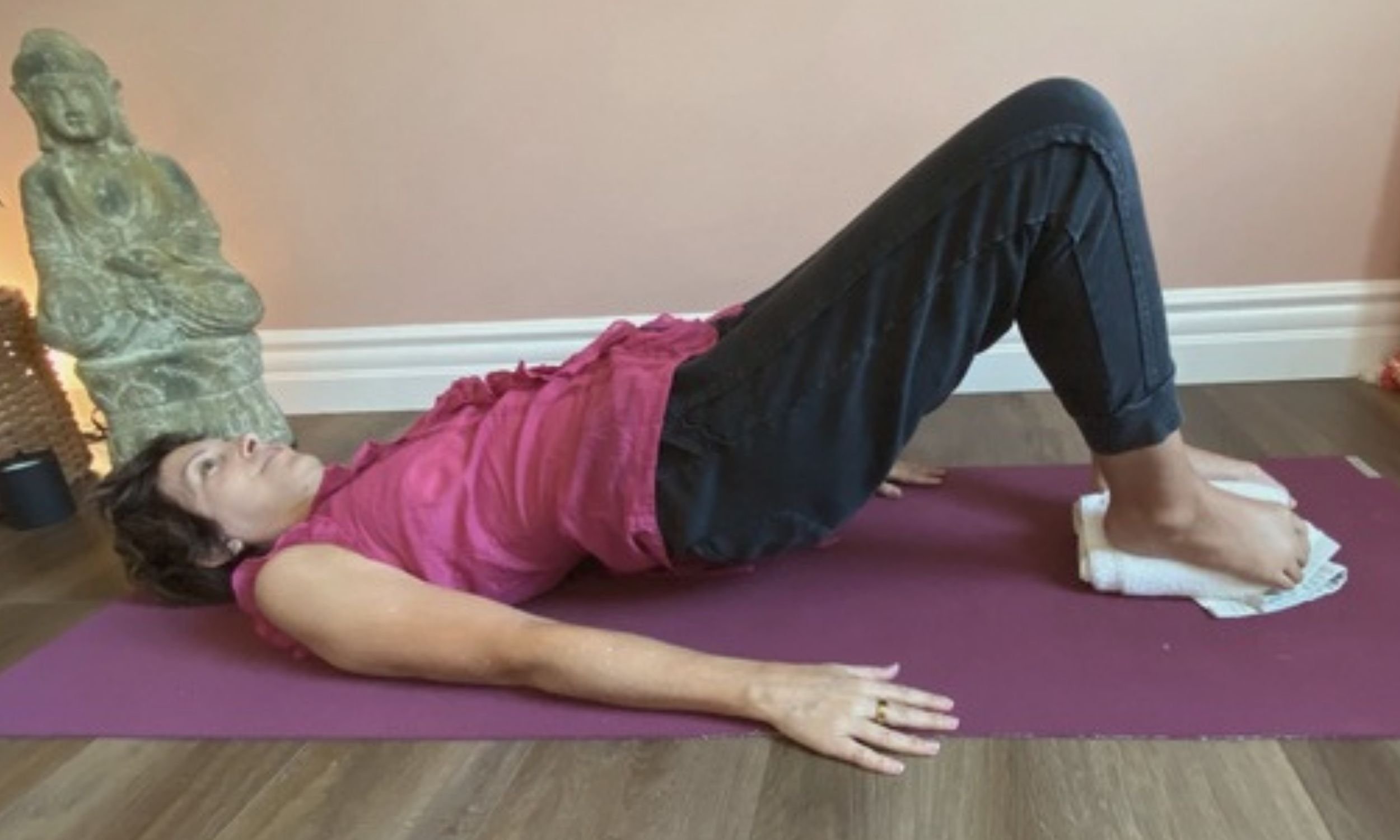
What to do instead: Go upside down in ways that keep you safe and still deliver the goods. Downward facing dog is an inversion. Legs up the wall is a deeply restorative inversion. Bridge pose, or supported bridge with a block under your sacrum, gives you that chest-opening, energy-shifting quality without any neck compression. The benefits of going upside down are real — the method is negotiable.
3. Child's Pose (Balasana)
I know. I can hear the gasps.
Child's pose is yoga's universal rest pose. It's the place we go when we need to breathe, to reset, to not do the thing the teacher is asking us to do. And for many bodies — knees that feel at home in deep flexion, hips that fold easily, a lower back that genuinely releases in that shape — it's wonderful. Keep it.
But for a significant number of women, child's pose is something they do because they think they're supposed to, while quietly enduring knee pain and wondering if something is wrong with them. Nothing is wrong with you. The pose just isn't right for your knees right now.
Your body weight resting on deep knee flexion is a lot to ask. And "hips to heels" — that classic instruction — is an additional demand on top of that. If your knees are registering a complaint, they're giving you useful information.
What to do instead: Puppy pose (extended child's pose with hips over knees rather than sitting back) gives you the shoulder and spinal release without the deep knee bend. A folded blanket behind the knees dramatically reduces compression. A bolster or firm pillow under your torso lets you rest without loading the joint. And if none of those work — child's pose is not mandatory. You have permission to skip it entirely – sit or lie down for a break.
4. Deep Lunges
The lunge family is a staple of yoga. Warriors, crescent, lizard, all the variations. And again — the movement pattern itself is valuable. Lunging is functional, it builds lower body strength, and it has a real place in a well-rounded practice.
The problem is that yoga has historically treated the lunge as primarily a stretching pose. Get that back hip flexor long. Push into the end range. Feel the burn of that deep pull across the front of the hip.
But for most women — especially in midlife — what we actually need in our hips and legs is strength, not more flexibility. We need more support, not more stretching. Pushing into the end range of a lunge puts real strain on the hip flexors, the hip joint itself, and the SI joint. I hear it constantly from students: "My SI joint keeps getting thrown out in lunges." That's not bad luck, it’s an imbalance.
What to do instead: Shorten your stance significantly — a box lunge (on the back knee, hip over knee; front leg at 90 degrees at the hip and knee, making a “box” shape with your legs and the floor) rather than a full lunge is great. You can use a wall or chair for support. And try this: instead of reaching into the stretch, gently "hug" your legs toward each other using subtle isometric engagement. You'll feel the difference immediately. You're building strength in the position rather than passively hanging in it. That's where the real work — and the real benefit — lives.
5. Pigeon Pose
Pigeon is beloved. I understand why. When it's working, there's nothing quite like it — that deep hip opening, the release through the outer hip and glute, the sensation of tension finally letting go.
When it's not working, you're potentially pressurizing your knee, gripping through your hip, and bracing for the moment the teacher finally says you can come out. Like the lunge, it’s not ideal to go to max range here. There are better ways to get that release.
Additionally, pigeon primarily stretches along one plane — the front-to-back (sagittal) plane. But your hips move in multiple directions, and the tightest lines for many people run diagonally or laterally, not straight back.
What to do instead: Supine figure-four (lying on your back, crossing one ankle over the opposite thigh) gives you the same outer hip release with zero knee compression and full control over the depth. Seated figure-four does the same thing in an upright position. Better yet, try finding those diagonal and lateral lines — a standing "pigeon" with your shin resting on a bed or sturdy chair lets you adjust the angle until you find exactly where your hip is holding tension. Just as much gorgeous release… and a safer container for it.
A Note About Coming Back
Here's the real thing I want to say — the thing underneath all of these individual poses.
I recently came back to a more active yoga practice after a few years focused primarily on strength training. I love strength training. I'll be writing about it a lot this year. But I missed yoga, and I was ready to return to the familiar shapes my body has known for decades.
Except my body has been through some things. A hysterectomy. Menopause. Wrist surgery. Knees that now voice opinions I didn't used to hear. And I discovered, with some humility, that poses I used to move through without a second thought were suddenly inaccessible — or accessible only with a conversation, a modification, a willingness to meet my body where it actually is rather than where I remember it being.
I haven't had what I'd call a "fancy" practice in years. But even unfancy poses were humbling when I came back to them after time away. It reminded me of something I believe deeply and tell my students often: if you stop doing something, you'll stop being able to do it.
Now, some poses are worth working back into — with patience, consistency, gentle coaxing over time. You just can’t skip the on-ramp. It might take time. Child's pose and I are in negotiations. The deep lunges I used to love are teaching me something new about strength. And some poses are simply ready to be edited out, not because they failed, but because what my body needs has changed.
The poses that don't serve you aren't the enemy of yoga. Clinging to them because they're familiar, because they feel like "real yoga," because you used to be able to do them and you're determined to get back there — that's where the trouble usually starts.
Your practice gets to evolve. That’s yoga.
This is one of the things we work on at It's All Yoga every single month — building a practice that actually fits the body you're in right now. If you're curious what that looks like, come take a look at what we're doing this month →

Michelle Marlahan has been teaching yoga since 2001 and is the founder of It's All Yoga, a virtual studio for women in midlife. Her teaching philosophy centers on alignment over ego, getting strong as slowly as possible, and the radical idea that you already have an A.