

The Fascia-Aging Connection: How to Feel Younger at 50+ Than You Did at 40
You reach down to pick something up and think, "When did bending over get hard?" You get up from the floor and need to use your hands. You turn to look over your shoulder and your neck doesn't turn as far as it used to. You wake up stiff and need ten minutes of shuffling around before your body remembers how to move normally.
This is what most people accept as "just getting older."
But here's what research on fascia is revealing: much of what we call aging is actually dehydrated, immobile fascia. And unlike chronological age, fascia is something you can directly influence.
What Makes You Feel “Old”? Hint: It’s Not your Birthday
When people say they "feel old," they're often describing a visceral sensation in their body:
Stiffness: That creaky, tight feeling when you first move
Limited range of motion: You can't reach as far, bend as deep, or twist as freely
Slower recovery: What used to bounce back now lingers for days
Loss of spring: Movement feels effortful instead of easy
"Brittle" feeling: Like your body might break if you push it
All of these sensations share a common thread: they're symptoms of dehydrated, restricted fascia.
Your Fascia: the Age Indicator You’ve Never Heard Of
Fascia is the connective tissue web that wraps every muscle, organ, and bone in your body. It's one continuous structure, creating fascial lines from head to toe. And here's the critical piece: healthy fascia is 70% water.
When fascia is hydrated and mobile, you feel:
Supple and fluid in your movements
Quick to recover from activity
Spring-loaded and elastic
Younger than your chronological age
When fascia is dehydrated and stuck, you feel:
Stiff and creaky
Limited in your range of motion
Slow to recover
Older than your actual years
The difference between a juicy peach and fruit leather? That's the difference between hydrated and dehydrated fascia. And it's the difference between feeling vibrant at 55 and feeling decrepit at 45.
Why Fasica Degrades as We Age (and Why It Doesn’t Have to)
Research shows that fascia naturally changes with age. Collagen fibers become more densely packed. Elastin decreases. The tissue loses water content and becomes less pliable.
But here's what the research also shows: these changes are dramatically accelerated by inactivity and repetitive movement patterns. In other words, it's not aging itself that destroys your fascia—it's how you move (or don't move).
The Three Fascia-Aging Accelerators
1. Sedentary lifestyle
Sitting for hours every day creates fascial adhesions—places where the tissue literally sticks together. Without regular, varied movement, fascia loses its ability to slide and glide. It becomes dense, restricted, and immobile.
2. Repetitive movement patterns
You walk the same way every day. You sleep in the same position. You do the same workout routine. Over years and decades, your fascia adapts to these patterns—becoming specialized and restricted everywhere else. The body you have at 50 is the body that's been shaped by your movement habits for the last 30 years.
3. Dehydration at the tissue level
You might drink plenty of water, but if your fascia is stuck and immobile, that water can't get where it needs to go. Fascia is like a sponge—if you never squeeze it, old water stays trapped and fresh water can't come in. Without compression and movement, your tissues remain dehydrated no matter how much you drink.
The result? By midlife, most women have fascia that's dense, dehydrated, and significantly less mobile than it was in their 20s and 30s. This is the “omg, I’m so old” feeling.
The good news: Fascia is Trainable at Any Age
Here's where this gets exciting: unlike many aspects of aging, fascia responds to intervention. It's plastic, adaptable, and trainable—even in your 50s, 60s, 70s, and beyond.
Studies on fascia show that with consistent, intelligent movement practices:
Fascial density decreases (tissue becomes less stuck)
Hydration increases (more water content in the tissue)
Elasticity improves (you get your spring back)
Range of motion expands (you move more freely)
In practical terms? You can feel younger at 55 than you did at 45. You can reverse the stiffness, regain lost mobility, and move with the ease you thought was gone forever.
But you have to work with fascia the way fascia responds. And that's not the way most people are moving.
What Doesn’t Work: The Conventional approach
Most midlife women are doing some combination of the following:
Regular stretching (30-60 second holds)
Yoga classes with familiar flows
Walking or cardio for exercise
Drinking water and taking supplements
These are all good things. But they're not enough to address fascial health.
Here's why:
Short stretches don't reach fascia. Muscles respond to 30-60 second holds. Fascia needs 2-5 minutes to actually change and rehydrate.
Familiar movements don't challenge fascia. Fascia thrives on novelty and variety. If you're doing the same yoga flow, the same walk, the same workout, your fascia adapts to those patterns and restricts everywhere else.
Water alone doesn't hydrate fascia. You need mechanical load—compression, stretching, and dynamic movement—to pump fluid through the tissue. Drinking water without movement is like watering a plant with roots that can't absorb it.
This is why you can be "doing everything right" and still feel stiff and creaky.
What actuALLY WORKS: tHE FASCIA-fOCUSED aPPROACH
To reverse fascial aging, you need three types of movement:
1. Compression (Self-Myofascial Release)
Using a tennis ball, foam roller, or your own hands, you apply sustained pressure to dehydrated tissue. This compression squeezes out old, stagnant fluid. When you release, fresh fluid rushes back in—like wringing out and re-wetting a sponge.
Why this works:
Compression directly addresses tissue density and adhesions. It breaks up the "stickiness" that develops from years of the same movement patterns. Regular compression work keeps fascia mobile and responsive instead of dense and stuck.
How to practice:
Tennis ball under your feet (arch, heel, ball of foot)
Ball between shoulder blade and wall
Side-lying with ball at hip or outer thigh
20-30 second holds, breathe into the pressure
Aim for "pain-free pressure"—discomfort yes, sharp pain no
2. Long-Hold Stretching (Yin Approach)
Yin-style stretching holds passive poses for 2-5 minutes, giving fascia the time it needs to soften, release, and rehydrate. This isn't about forcing flexibility—it's about giving tissue time to change.
Why this works:
As we age, fascia becomes more densely packed and less pliable. Long holds allow the tissue to literally reorganize at the cellular level. You're not just stretching—you're remodeling the fascia itself.
How to practice:
Dragon pose (low lunge) for hip flexors: 3-5 minutes per side
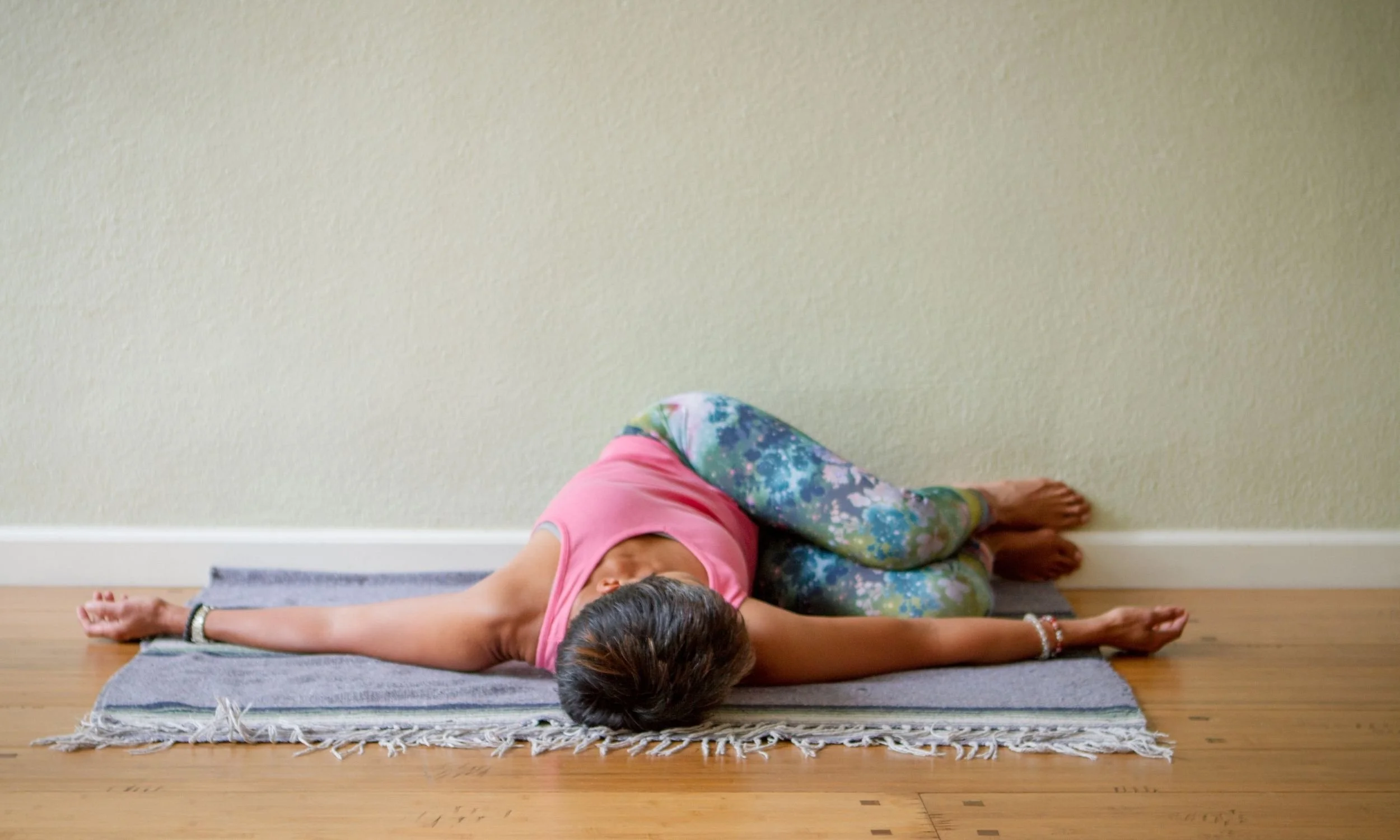
Reclined twist for side body: 3-5 minutes per side
Supported bridge for chest and shoulders: 3-5 minutes
Wide-leg forward fold for inner thighs: 3-5 minutes
Find your edge, back off 10%, breathe, and wait
3. Dynamic, Multi-Directional Movement
Fascia is designed to be elastic—to store and release energy like a spring. But it needs bouncing, spiraling, multi-planar movement to maintain that quality. This is the opposite of controlled, repetitive exercise.
Why this works:
The "spring" in your step—the elastic recoil that makes movement feel effortless—comes from healthy fascia. Dynamic movement trains this quality, keeping you feeling light and responsive instead of heavy and plodding.
How to practice:
Add small bounces to yoga poses (cat/cow, downdog, side bends)
Practice movements in all planes: forward/back, side to side, rotation
Explore spirals through the spine
Squat pulses, heel raises with bounce
Emphasize variety and novelty over perfect form
tHE tIMEline: What to Expect
Immediately:
After compression work or yin stretching, you'll notice changes in how that area feels. More space. More ease. More fluid movement. This is your nervous system registering the release.
Within 1-2 weeks:
With daily practice (even just 5-10 minutes), you'll start to feel less stiff in the morning. Getting up from the floor gets easier. Bending down doesn't require as much mental preparation.
Within 6-12 weeks:
This is when fascial remodeling happens. The tissue itself is changing—becoming more hydrated, less dense, more elastic. You move with a quality you haven't felt in years. You might notice you're standing taller, reaching farther, recovering faster.
Long-term (6+ months):
Fascial health becomes your new baseline. The stiffness, limitation, and "feeling old" you accepted as inevitable? Gone. You've reversed fascial aging through consistent, intelligent practice.
This isn't about turning back the clock. It's about optimizing the body you have now and preventing further degeneration.
Real-Life Impact: What Changes
When you prioritize fascial health, the changes show up in everyday life:
Getting out of bed: No more shuffling around for ten minutes waiting for your body to "warm up"
Bending down: You can reach the bottom shelf, tie your shoes, pick things up without bracing yourself
Looking over your shoulder: Full rotation returns—backing out of parking spots gets easier
Getting off the floor: You can sit down and stand up without using your hands
Recovery time: What used to leave you sore for days now bounces back quickly
Overall sensation: You feel fluid, capable, and younger in your body
These aren't small changes. These are the markers of functional independence as you age. These are the things that determine whether you're thriving at 70 or struggling.
Your 5-Minute Daily Fascia Practice
You don't need hours. You need consistency and the right techniques. Start here:
Morning Fascial Wake-Up (5 minutes):
Foot rolling (1 min): Tennis ball under each foot while you make coffee
Cat/cow with bounce (1 min): Wake up your spine with small pulsing movements
Hip release (1 min): Ball at hip flexor or standing hip circles
Multi-planar reach (1 min): Overhead, side, rotation, down—all directions
Rest (1 min): Constructive rest on your back, knees bent, everything settles
Evening Fascial Wind-Down (5 minutes, optional):
Shoulder release (2 min): Ball between shoulder blade and wall, breathe
Reclined twist (2 min): One side, let gravity work
Constructive rest (1 min): Integrate
Do this for 30 days. Notice what changes. Your body will tell you this works.
The Anti-Aging Strategy You’ve been Missing
The wellness industry sells you creams, supplements, and workouts that promise to make you look younger. But feeling younger in your body? That's about fascia.
This is cellular-level anti-aging work. This is what determines whether you move with ease or effort, whether you feel capable or fragile, whether you thrive or just survive in your later decades.
The truth is, you can't stop chronological aging. But you can absolutely reverse fascial aging. You can feel more mobile at 55 than you did at 45. You can move with more ease at 60 than you did at 50. You can maintain—or even improve—your spring, your suppleness, your sense of possibility in your body.
Your fascia is listening. Give it compression. Give it long, patient stretching. Give it dynamic, varied movement. Give it what it needs, and it will give you back the vitality you thought was gone.
This is how you age well. Not by fighting your body, but by understanding how it works—and working with it.
Ready to feel springy? This February, I'm teaching everything I know about fascia—the science, the techniques, and the daily practices that keep you feeling supple, mobile, and alive at any age. Join me inside It's All Yoga for Hydration + Fascia month.

Michelle Marlahan is the founder of It's All Yoga, now a thriving online studio offering 10 live classes weekly and hundreds of recorded sessions ranging from 10-60 minutes. Her approach balances nervous system regulation with strength building specifically for women in their 40s-70s who value the privacy, autonomy and flexibility of virtual yoga practice. She also works privately with women who have pelvic pain, incontinence or prolapse to find balance and healing in the hips, low back and pelvic floor.